
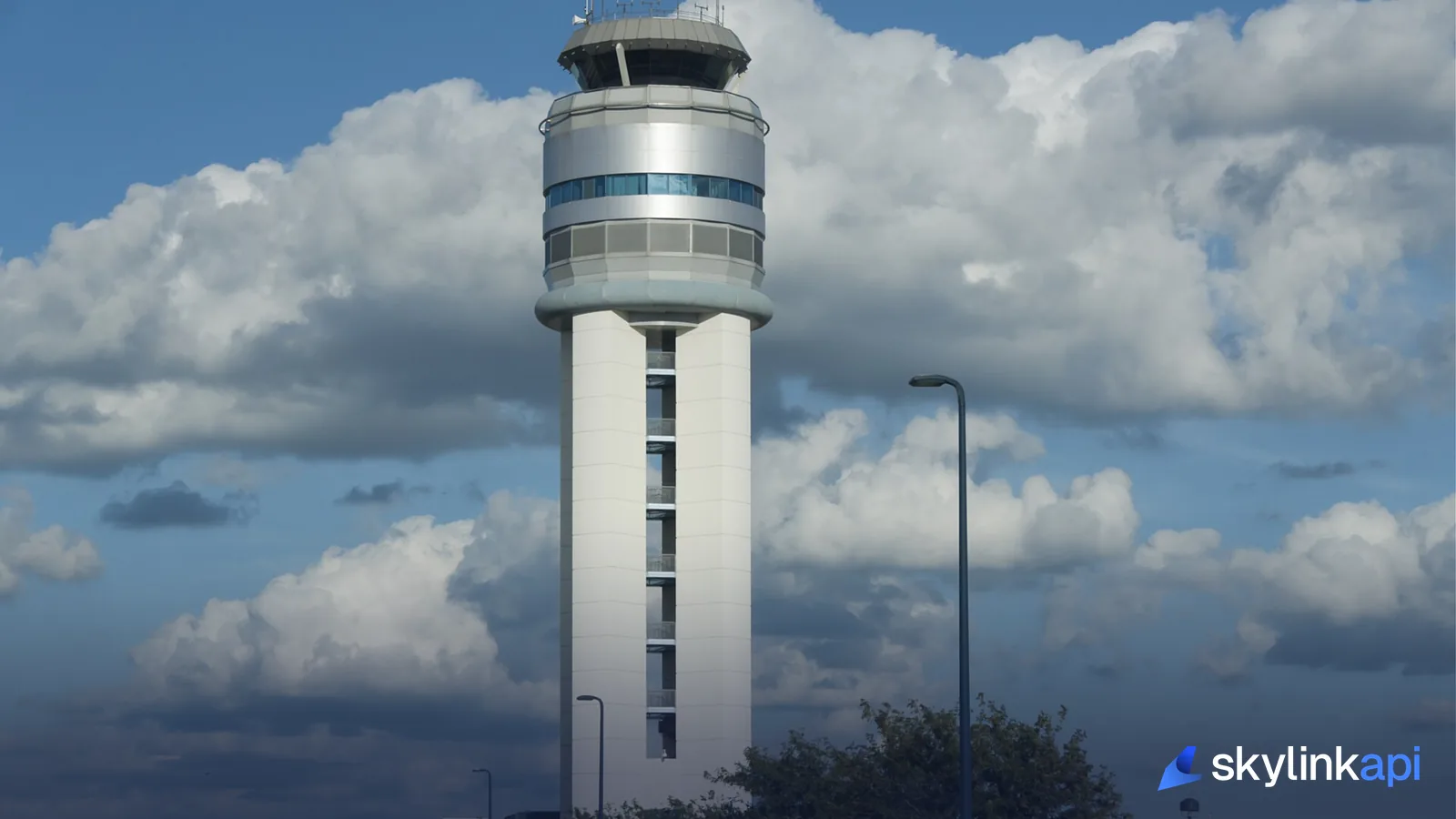
Most people who think about airport operations picture a control tower. The tower manages the runway and the immediate airspace around it. Everything else — gates, ground vehicles, baggage, de-icing pads, passenger connections — is managed by a different set of teams, and those teams live and die by one input: knowing where each inbound aircraft is and when it will actually arrive, not when it was scheduled to arrive three hours ago.
This post walks through the specific operational problems that live flight data solves at an airport, and what the integration looks like from a systems perspective.
Gate management is the one everyone underestimates
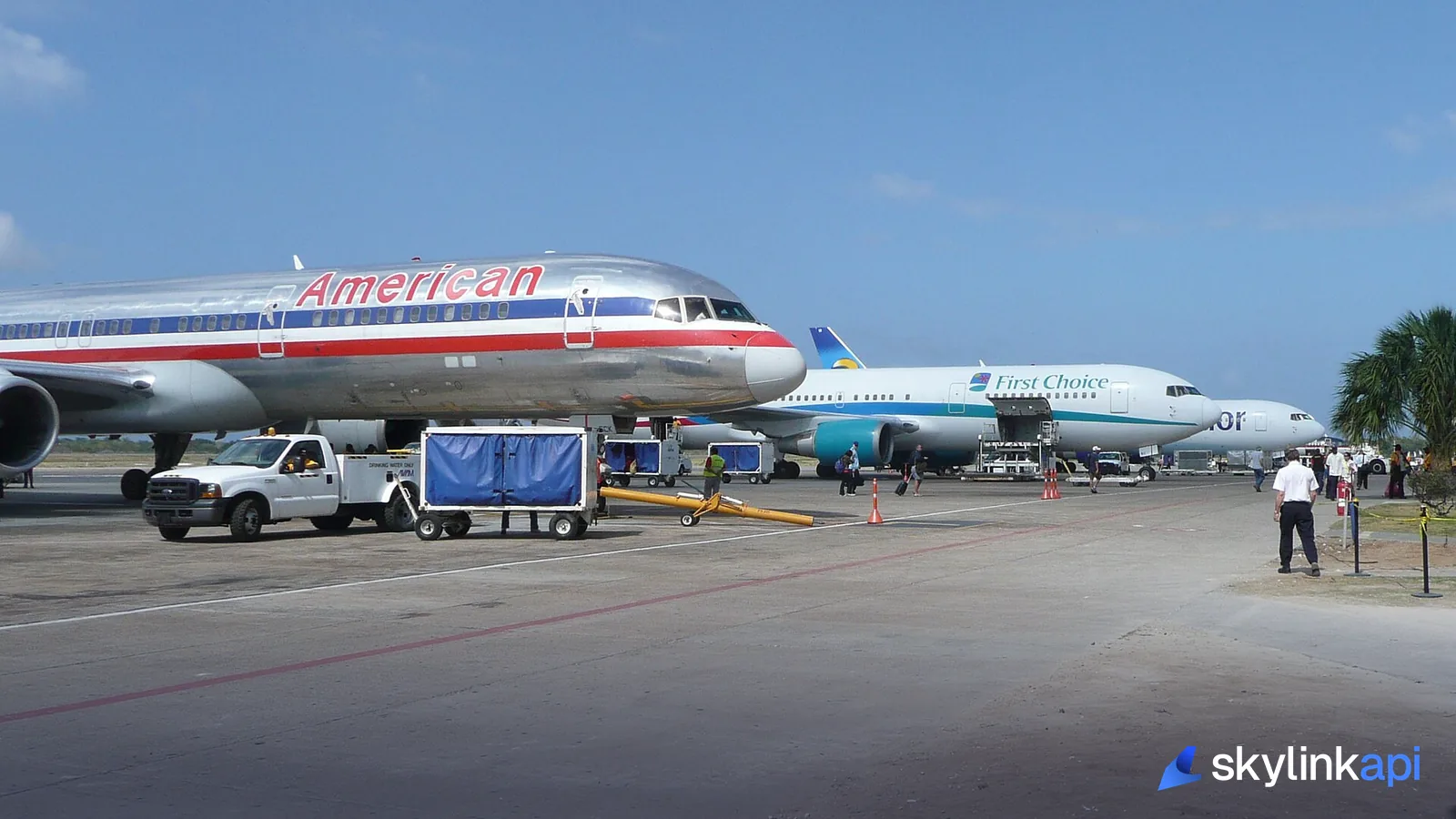
A large hub might have 120 gates and 800 movements a day. The gate plan is built from the schedule, but the schedule starts drifting the moment the day begins. A flight lands 20 minutes late, its gate is still occupied by a pushback that ran long, and now the arriving aircraft needs somewhere else to park — in the next four minutes, because it's already on the taxiway.
Gate management software needs two things from a flight data feed:
-
Accurate ETA, updated continuously. Not the airline's filed arrival time, which was set at dispatch and may not reflect headwinds, holds, or a runway change. The feed needs to reflect current position, ground speed, and remaining distance. SkyLink's flight time prediction endpoint returns an estimated arrival based on live position and historical block times for the route, which is closer to what gate planners actually need than a static schedule.
-
On-ground state transitions. The gate plan cares about three moments: wheels-down, gate-in (block-in), and pushback (block-out). ADS-B gives you the first one reliably —
is_on_groundflips totrueand the position stops updating at cruise speeds. Block-in and block-out are harder from ADS-B alone, but you can approximate them: an aircraft that has been stationary at a known gate position for more than 90 seconds has almost certainly blocked in.
import requests

BASE = "https://skylink-api.p.rapidapi.com"
H = {"X-RapidAPI-Key": KEY, "X-RapidAPI-Host": "skylink-api.p.rapidapi.com"}

# Poll inbounds to KJFK
r = requests.get(f"{BASE}/schedules/departures", headers=H,
                 params={"icao": "KJFK", "type": "arrivals"})
arrivals = r.json()

# For each inbound, get live position
for arr in arrivals.get("data", [])[:10]:
    cs = arr.get("callsign", "").strip()
    if not cs:
        continue
    pos = requests.get(f"{BASE}/adsb/aircraft", headers=H,
                       params={"callsign": cs})
    ac = pos.json().get("aircraft", [])
    if ac:
        a = ac[0]
        print(f"{cs}: alt={a.get('altitude')} gs={a.get('ground_speed')} "
              f"on_ground={a.get('is_on_ground')}")
Gate conflicts at a busy hub cost real money. A widebody parked at the wrong gate for 30 minutes blocks another widebody that needs a bridge, which forces that second flight to a remote stand, which means a bus operation, which means 15 minutes added to the connection time of every passenger on board. One bad gate assignment cascades.
Turnaround timing
The turnaround — everything that happens between block-in and pushback — is the bottleneck of airport throughput. Cleaning, catering, fuelling, boarding, baggage. Each of those has a team, and each team's dispatcher wants to know when the aircraft will be at the gate so they can stage resources.
A cleaning crew that shows up 10 minutes early stands around waiting. One that shows up 10 minutes late delays pushback. In both cases the root cause is usually the same: they were working from the scheduled arrival, not the actual position of the aircraft.
Feeding a live ETA into turnaround management means those teams can stage just-in-time. The numbers are not dramatic per flight — you save maybe 5 minutes on average. Across 800 movements a day, that's 60+ hours of cumulative resource time recovered.
De-icing sequencing
Airports in cold climates run de-icing as a queued operation. Aircraft push back, taxi to a de-icing pad, get sprayed, and then have a limited holdover time to reach the runway before the fluid loses effectiveness. If they miss that window, they go back for a second application.
The queue is managed by a de-icing coordinator who needs to know which aircraft are about to push and in what order. Schedule data is almost useless here because pushback times have drifted from the plan by this point in the day. What works is watching the ADS-B ground track: an aircraft that starts moving from a gate position is pushing back, and you can estimate its taxi time to the pad from the gate location.
# Check current ground traffic at an airport
r = requests.get(f"{BASE}/adsb/aircraft", headers=H,
                 params={"bbox": "40.61,-73.82,40.66,-73.75"})  # JFK bbox
ground = [a for a in r.json().get("aircraft", [])
          if a.get("is_on_ground")]
for a in ground:
    print(f"{a.get('callsign','???'):8} gs={a.get('ground_speed',0):3} "
          f"lat={a.get('latitude'):.4f} lon={a.get('longitude'):.4f}")
A second de-icing application costs the airline $3,000–$8,000 depending on the aircraft type and fluid. For the airport, it costs a departure slot. Better sequencing avoids both.
Connection protection
When an inbound flight is late and passengers on board have tight connections, someone has to decide: hold the connecting flight, or let it go on time? That decision depends on how many connecting passengers there are, how late the inbound actually is (not how late it was 20 minutes ago), and whether a hold is operationally feasible given downstream slot constraints.
The connecting-passenger count comes from the airline's reservation system, not from flight data. But the "how late is it really" part comes directly from live position data — specifically, a current ETA that accounts for the aircraft's actual location and ground speed, not the last estimate the airline published to their departure-control system.
Getting this wrong in either direction is expensive. Holding a connecting flight for 15 minutes delays 180 passengers to protect 12. Not holding it when the inbound is only 4 minutes out means 12 passengers miss the last flight of the day, need hotel vouchers, and are unhappy about it publicly.
What the integration actually looks like
Airport operational databases (AODB) are the system of record for flight information at most airports. They're typically fed by SITA or ARINC messages from airlines, supplemented by local radar and manual updates. Adding a live ADS-B feed means running a polling loop against the API and writing updates into the AODB, or into whatever downstream system consumes the data.
The polling pattern is straightforward: call the bounding-box endpoint for the airport's terminal area every 5–15 seconds, match aircraft to expected movements by callsign or ICAO24 hex code, and update the arrival estimate whenever the position changes. For airports that want a broader view — inbounds still 200 miles out — widen the bounding box or query by callsign for each expected arrival.
The health endpoint (GET /adsb/health) is worth integrating too. An airport system that relies on the feed should monitor its status independently, not discover a feed outage when gate assignments start going wrong.
One operational note: ADS-B coverage at ground level varies by airport. Surface movement is generally well-covered at airports that have receivers on-field, but taxiway-level tracking can be patchy at airports that rely on distant receivers. The statistics endpoint gives you a count of how many aircraft the feed currently sees on the ground globally, which is a useful sanity check but not a per-airport guarantee.
Getting started
If you're building airport-side tooling and want to test this against a real feed, the free trial gives you enough calls to prototype a gate-management or turnaround-timing integration. The endpoints used above — bounding-box queries, schedule lookups, flight time predictions — are all in the standard API. For production airport deployments that need higher throughput or contractual uptime, Enterprise plans include the 99.9% SLA and dedicated support.